The New Science of Infotrition
A new science, inspired by nutrition, for the media's impact on our minds, individually and collectively.
What, Why, How
What:
A new science to standardize how we measure media's likely impact on our minds and emotions, enabling a new way of labeling, understanding, and safely, apolitically regulating how media affects us, individually and collectively.
Why:
Modern media, through techniques and interfaces designed for maximum engagement, prey on our human weaknesses. Just the same way processed sugar, excess salt and fat, artificial colorants, synthetic preservatives, etc. can be used as a cheat code for food and drink producers, media publishers and influencers can use the cheat codes of attention ingredients: violence, tragedy, ragebait, controversy, conspiracy, exaggeration, logical fallacies, and more. They both manipulate perception for profit, at the expense of the consumer's wellbeing. Nutrition science and guidelines allowed us to identify the ingredients with which we feed our bodies, warn people, set standards, and hold those who abused their use accountable. We need to be able to do the same for how we feed our minds. For four primary reasons.
- As consumers, we are currently operating blind, gorging ourselves on the equivalent of unlimited stimulants and grease, with zero tangible awareness. We can see the signs all around us, from hyper-polarization, to depression, breaks with reality, news fatigue, and more. A sense of collective rage, fried emotions, and intellectual paralysis. Given the amount of money and attention being poured into mental health, while people simultaneously spend most of their waking hours in this media environment, it is a glaring blind spot. It is especially glaring for educators and parents:
- given the efforts to teach young people to be mindful of how they feed themselves, and how the health of their environment affects their health, with media literacy taught separately, this is a powerful missing bridge to make the latter far more relatable and compelling.
- given the intense concerns by parents about the impact of the media their children consume, this would be an incredibly helpful reference.
- Without such a science, it is impossible to hold producers accountable. Those without morals chasing power at any cost will continue to dominate our media with impunity, leading to an inevitable erosion of democracy and integrity in public life. Any lawmaker that tries to punish toxic producers without a data-driven, transparent, repeatable, neutral system, will be immediately labeled as a politically-motivated totalitarian censor. Such concerns are reasonable: even if you are not directly banning any speech, labeling it negatively or imposing fines on it is a form of restriction. The justification for doing so must be completely inarguable through its neutrality, transparency, and consistency. The only way to do this is to base it in a real, reliable science.
- Research repeatedly shows that toxic content significantly and reliably outperforms calm, honest, reasonable content, which strongly suggests humanity is openly driving itself into epistemic collapse. When ignorance beats knowledge, noise beats substance, and provocation beats reason, we doom our survival as a species. Quality journalism and media producers have been forced into a race to the bottom to survive because there was no consequence to using these cheap techniques, only upside; if they didn't play the game, they were guaranteed to lose out to those who do. A science of infotrition can introduce accountability that levels the playing field, for the first time creating a race to the top instead, appealing to a mainstream consumer audience concerned with the impact of the media on their minds and that of their friends and family.
- A science is necessary to properly measure, study, and deepen our understanding of the impacts of media on individuals and entire populations, enabling an entire new area of research that can illuminate everything from mental health to political science, transforming how we, as humans, understand our relationship with the very thing that defines us a species: the management and proliferation of information. We already know that online content creates anxiety and anger and insecurity, all of which create stress which in turn produces an inflammation response in the body.
How:
Infotrition is made possible using machine learning models that are trained to detect their respective infotrition components (see list of initial ones below), with a second layer of LLM analysis and commentary to further refine and clarify detection. The data used to train each model will be public, itself annotated by an LLM to explain and refine selection.
When components are listed, they will be hyperlinked directly or via QR code, allowing somebody to trace the figures directly back to specific parts of the content, to see for themselves, view explanations, and even dig into the training data if they would like to.
It is essential that this science is as transparent, objective, and repeatable as any other respected field of science.
Components of Infotrition (V1.3)
All of the below include a raw value, and a benchmark value to indicate where it is high or low. Good components are green, bad components red; high, when good, green; low, when bad, is red. When seen on a live piece of media, every component in the label is clickable to see the data and rationale completely. Nothing is hidden. Everything can be scrutinized.
Negative Components
- [%] Parent nutrient: Agitation
- [%] Sub-nutrient: Loaded language
- [%] Sub-nutrient: Hyperbole
- [%] Sub-nutrient: Appeals to emotion
- [#] Character attacks (Derogatory or denigrating language toward an individual)
- [#] Violence
- [#] Misogyny
- [#] Racism
- [High/Medium/Low/None] Encourages Fear
- [High/Medium/Low/None] Parent nutrient: encourages paranoia/ suspicion
- [#] Sub-nutrient: Encourages tribalism/ Us versus them
- [#] Sub-nutrient: Conspiracy theory detected
- [High/Medium/Low/None] Parent nutrient: Bias intensity
- [High/Medium/Low/None] Sub-nutrient: Blind spot intensity (Shows analysis of how commonly this story was covered by different parts of the political spectrum)
Positive Components
- [High/Medium/Low/None] Optimism
- [#] Compliments
- [High/Medium/Low/None] Unity
- [#] Humour
- [#] Nuance/ Added Context
- [High/Medium/Low/None] Both sides' views are represented, or meaningfully different perspectives shown
- [%] Details
- [#] uncontroversial facts or figures included
- [#] Explanation (explains how something works)
Reality Components (positive or negative scores)
- [#] Claims made
- [List] subject of the claims
- [%] accuracy via automatic claim check (AI) with confidence scores and transparent view of analyses for every claim analyzed
- [#] logical fallacies detected
- [List] Fallacies
Below these components, sub-chart showing how this source makes money:
- [Y/N] Selling products or courses that capitalize on the negative ingredients or negative reality ingredients
- [Y/N] Selling subscriptions (that capitalize on their engagement)
- [Y/N] Selling advertisements or promotions (capitalizing on their engagement)
The above relies on investigative journalism partners for now, and likely will expand to the option of a distributed, standards-based citizen journalism layer as well, contributing to a public ledger that is equally transparent and reasonably verifiable.
As research expands, added context will be included around how certain components, and in what quantities and frequencies, are likely to affect your wellbeing and in what ways, with links to the related research.
Key Nuances
- This new science is focused on enabling informed decisions, and actions with consequences, rather than any form of heavy-handed, opaque censorship.
- Infotrition prioritizes being informative more than prescriptive. Just as somebody can choose to eat fast food all day, every day, so, too, can somebody choose to intentionally consume high agitation, or high violence content, for example. What is important is them knowing they are doing so, and understanding the context behind it.
- Infotrition is not just about personal nutrition, it also speaks to the ingredients we find in our information environment collectively. At a macro level the analogy shifts to environmental pollution and protection.
The Consumption Dilemma / The Infinite Buffet:
A Short Story
We are living in a world that is missing a major, fundamental science. As a result we are blind to a defining aspect of our lives and health, individually and collectively. To understand the absence, necessity, and potential of Infotrition science, it’s helpful to consider how our world might be if we also lacked nutrition science. The results are familiar.
In the 50’s and 60’s, you could produce and promote almost anything. When it came to food and drink, companies took full advantage.
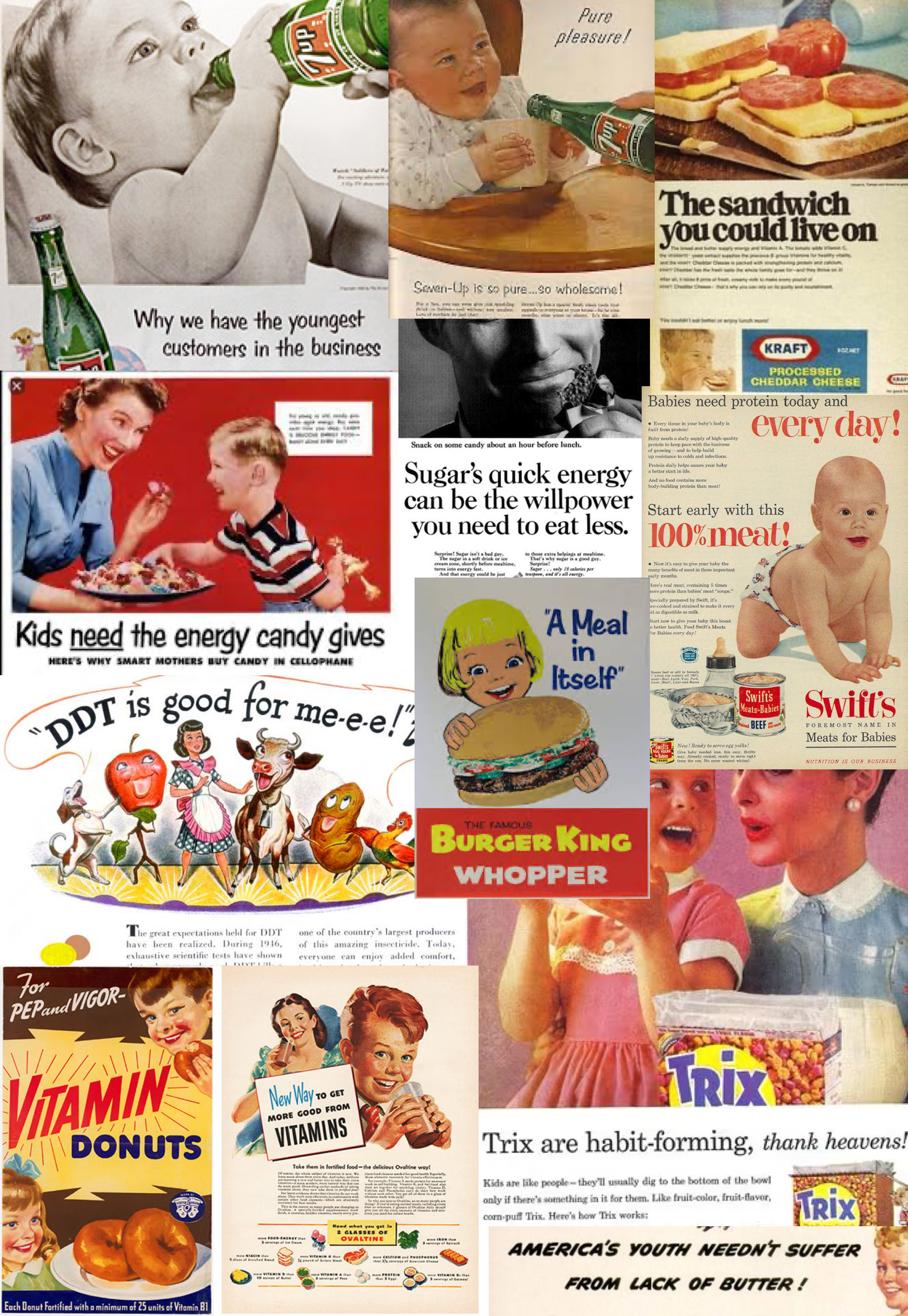
Fast forward. The year is 2002. History evolved in exactly the same way, except one big difference: mainstream nutrition science doesn’t exist. It never emerged, never took hold.
No nutrition education, no nutrition regulation, no nutrition guidance, no nutrition labels, no nutrition studies.
Fast food, junk food, and ultra processed food producers don’t have to deal with any of it. They are completely unimpeded in what they can create and sell. Major legacy producers, and revolutionary new startups crop up, all leaning in, because the technology has also evolved. A lot. The possibilities are exciting, and many speak of the uplifting nutritional and performance potential these capabilities unlock for humanity. The ability to create the perfect artificial ingredients with finely tuned physiological effects, the ability to target consumers, and to even create customized reactions on an individual basis, are now all possible. These capabilities are now the output of some of the most prevalent well-paying and in-demand jobs in the world.
Producers, equipped with these modern capabilities, have reached unprecedented scale and sophistication. They have taken full advantage of their ability to legally utilize the most highly satisfying ingredients and sensations, packaged in physiologically irresistible, tantalizingly convenient and attractive forms; they fund a flood of advertisements and prompts, nudging us into consumption. There is no expectation on anyone’s part of warnings or disclosures. It has become arguably the most lucrative unregulated business category in history.
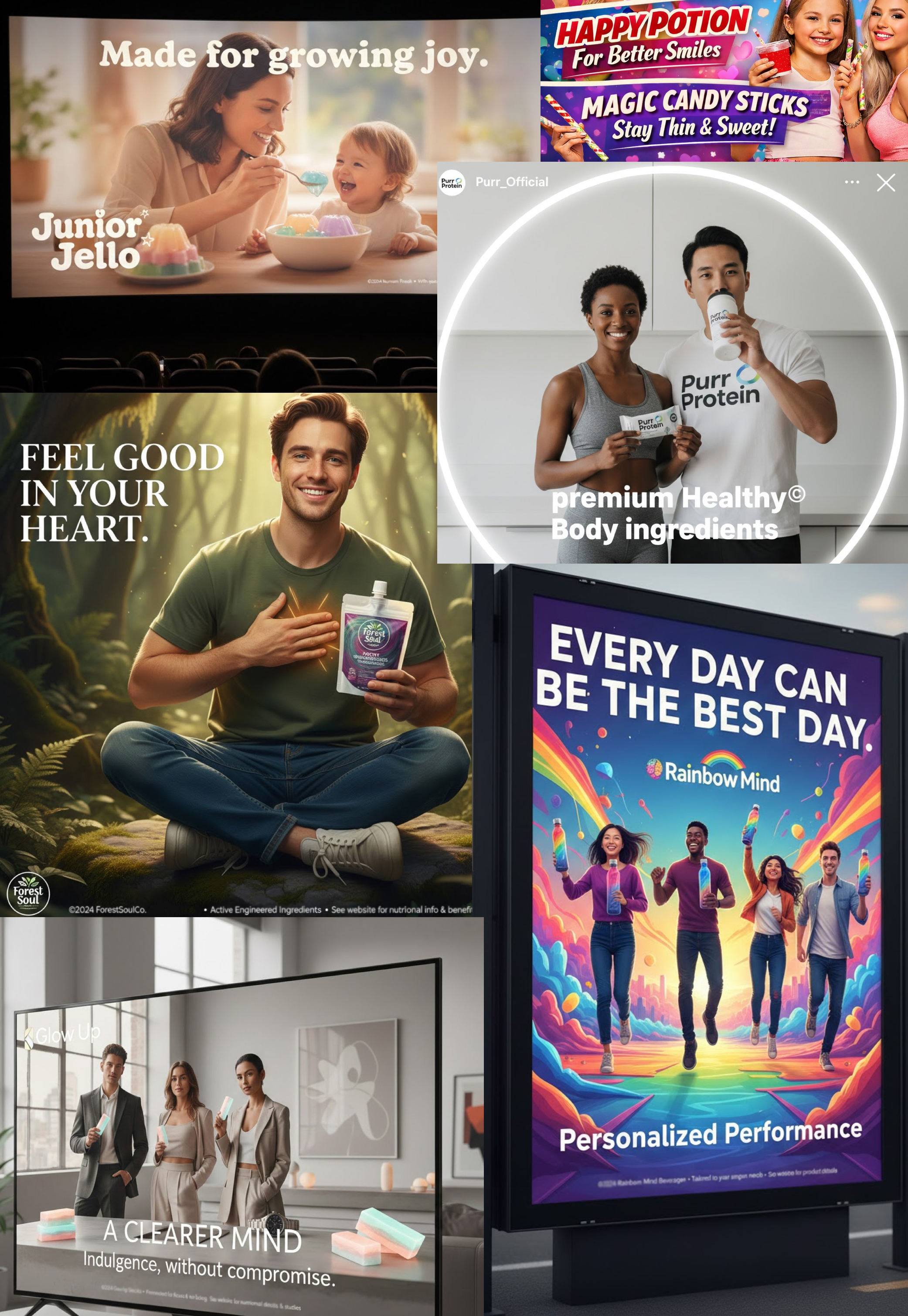
Of course, this means these companies are also unlimited in their ability to create a product so much cheaper, more attractive, more visible, and blindly enjoyable — even if devoid of any nutritional value — that healthy food producers simply can’t compete.
Fast-forward again.
It’s 2010. Healthy food producers are starting to go out of business. People fret about the death of local food producers, of trusted, healthy food; they are slow, boring, invisible, and comparatively expensive. They can’t keep up. Fewer and few options are available that aren’t highly processed and nutritionally compromised. Soon enough, almost all food is now processed food. What’s left is sponsored by the food and drink producers, showcasing their goodwill.
With its rampant, unchecked “success”, processed food have gradually become the default understanding of what food is and should be. Teenagers can now barely identify whole foods and have no interest in them. There are increasing signs that their minds are changing, bent to these new dependencies.
It’s now 2018. By defining our diets, making us dependent on how we function and feel, these companies have become the most powerful companies on earth. We barely noticed it happening. With their power and pervasive influence, they have branched out into all manner of areas, allowing smaller suppliers the world over to build on top of their ecosystem of perfectly-tuned and personalized ingredients and advertisements, encouraging them to do the same, creating inescapable integration into our economy and lives. They have developed overwhelming political lobbies like nothing ever seen before, and with their wealth, even more sophisticated ways of making the average person inescapably dependent.
They have perfected an artificial, addictive worldwide economic layer the majority of the world’s population comes to depend on, who can no longer imagine there is even a plausible alternative.
Of course, everyone knows something is wrong, and many can easily point the finger at these megacorporations. Everyone bemoans how ill they feel, how unhealthy society seems—as if it’s unavoidable. People complain how their children have become unhealthy beyond their control. How everyone seemed to have a horror story of that one relative who was destroyed by this unlimited system. And yet… it all feels so intangible. So nebulous. So hard to pin down. It’s everywhere. Where would we even start?
Without any mainstream nutrition science, there is no formal education around these subjects. This is left to small non-profits who selectively work with schools and try to use theory and education of whole foods to motivate students to make better decisions. It’s like trying to light a candle in a hurricane. In the face of a flood of ultra tempting food offerings designed to drive impulsive consumption, where there is no room to reflect or remember theory, these efforts feel promising in the moment—at least somebody is doing something —but are largely futile overall.
The year is now 2022.
More and more headlines appear in newspapers. Studies are showing the skyrocketing proportion of youth who are mentally unwell, the number of deaths from morbid obesity or strangely stunted nutrition; stories of people so malnourished and addicted and jacked up on perfectly addictive ingredients — gorged on empty, euphoric calories — that they went mad and hurt people around them.
Momentum starts building to create some sort of accountability, to create some laws that might change things. As this happens, the many, many smaller business owners that now depended on the success of these megacorporations eagerly demonized such efforts. “They’re trying to take your food away!” “They’re trying to starve you!” “Just like the elites to take away your choices!” “They’re trying to tell you how to feed your children!” “Who gets to decide what health is!?” “They don’t want you to feel good, then they can’t control you!”
The executives of these processed fast food megacorporations are dragged in front of congress. It captivates global attention. They are grilled by politicians. Their answers are quite reasonable:
“Congressman, we feed people. We bring people together around food.”
“We’ve increased access to food like never before.”
Parents of youth who died because of their irresistible, extreme offerings, are present, holding pictures of their late children. The executives, with sombre faces, say they’re very, very sorry, and that they’re doing what they can.
The proceedings end, and the politicians are stuck: it’s all so intangible. How can you really hold these companies accountable, demand such significant changes, simply because it seems like the right thing to do? They can already imagine the critics shouting: “that’s your opinion, that’s ideology!”, “They are killing innovation!”, “They hate progress!”, “Controlling our food supply like communists!”, “They decide on this now, what will they decide next!?”
The companies volunteer to make adjustments. Offering the exact same products, just as addictive, just as devoid of nutritional value — but now…
Now, when they release new products, as you make your decisions, buried somewhere below the tantalizing images, there is a small information box you can scan or tap into to get some opinions from other users, themselves pointing to other resources you need to click into and explore. Most of the time, the information boxes only get activated after about 10 million people have already eaten the item first. They have also hired over 10,000 food supply moderators who are responsible for flagging the most extremely addictive and violently unhealthy products that affiliates of the megacorporations make available through their channels. The megacorporations don’t stop them from being made available, or create any barriers accessing them, or any disincentives to how much money you can make through them — but these moderators are helping flag them. It’s something.
Predictably, things are only getting worse, while these companies, now wealthier than many nations, only get richer and more powerful.
If only somebody created a science to finally make it all measurable and accountable in an objective, data-driven and therefore defensible, politically neutral way…
The Power of Having a Science
It is helpful to recap the world-changing impact of nutrition science. This helps make clear how a new, data-driven science can similarly take hold. It all starts with identifying measurable ingredients.
Being able to quantify and understand what is in the food and drink we are putting into our bodies directly led to knock-on world-changing effects in our understanding of its impact, and resulting laws, education, human behaviour, and products.
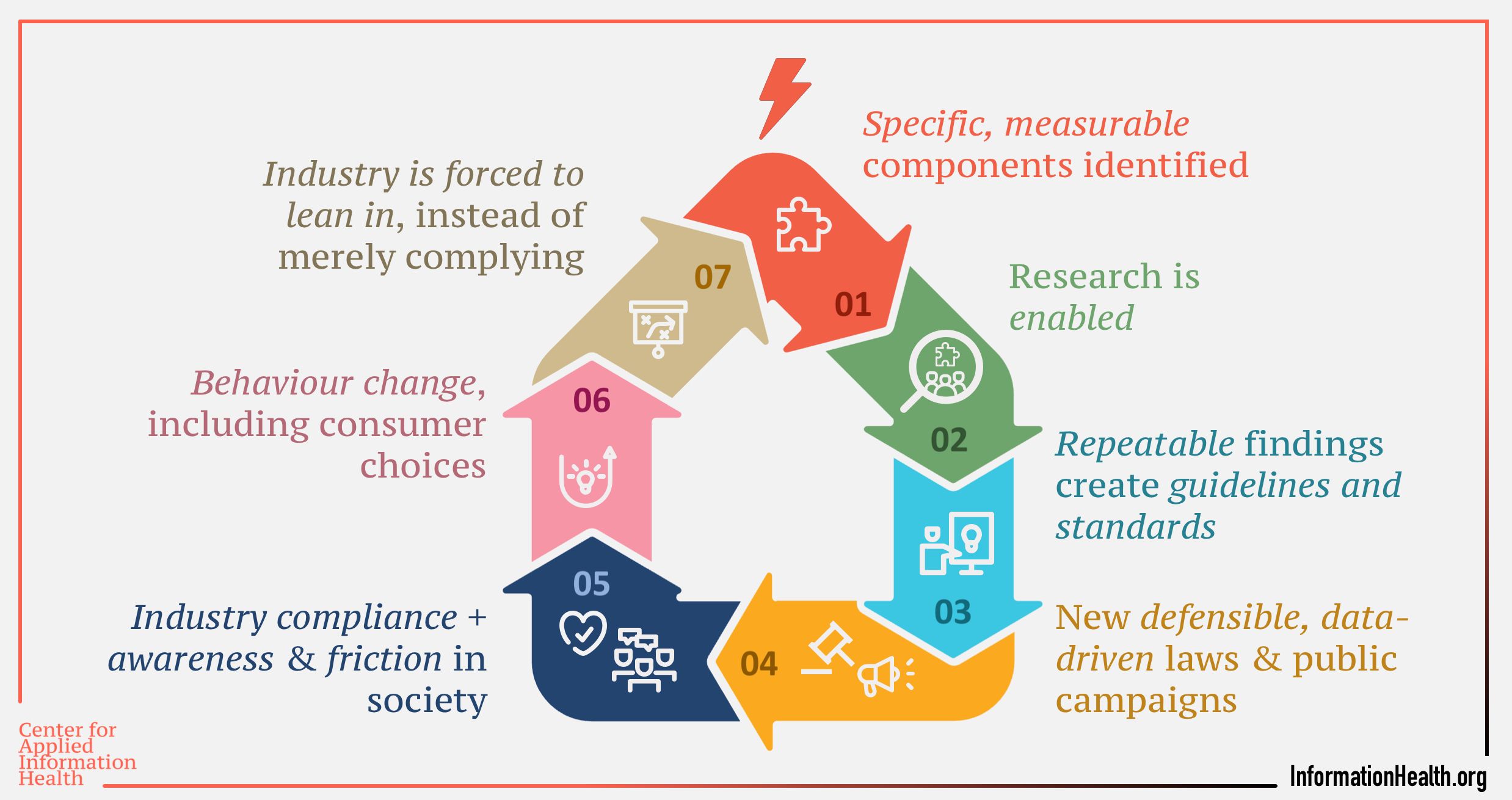
Being able to identify certain components of our diets allowed us to precisely research and identify the tangible impacts they had on our health, both short and long term.
- Vitamins (A, B, C, D, etc.) and minerals: In the early 1900's, they helped pinpoint the causes of scurvy (vitamin C deficiency), rickets (vitamin D deficiency), and other such diseases.
- Sodium: In the 1960s, the adverse effects of excess sodium were discovered.
- Sugars: In the 1970s, the adverse effects of excess sugar, particularly processed sugar.
- Trans Fats: now linked to cardiovascular disease risk.
- Broader nutrient awareness in the context of processed foods: the discovery that processed foods often lacked essential nutrients began transforming public health policy in the first half of the 20th century.
This understanding, in turn, made it much easier to create healthy guidelines and standards, and for policymakers to create laws accordingly.
These laws, when anchored and justified by public data, have had broad impact:
- On the producer side,
- limits were set on what could be included in foods and drink, and in what proportions;
- producers were also obliged to disclose what was in what they were selling, in the context of the new guidelines and standards. You would be hardpressed to buy a product meant for consumption anywhere in the developed world without some form of ingredient label (itself ordered by volume), and nutrition label highlighting important aggregate aspects across the ingredients.
- Finally, producers were barred from how they could promote unhealthy consumption habits or unhealthy food items. Violators were easy to identify and hold accountable because they were measurable.
- In our education systems, schools were mandated to educate children about these concepts, to understand the composition of what they eat and drink, how it impacts their health, and best practices around their diet to live a healthy life. All of this made possible because it was backed by science, from the definition of nutritional terms, to the impacts. Objective, repeatable, and transparent.
We know what happened next. This widespread education and perpetual awareness — staring you in the face every time you pick an item to eat or drink, whether it's at the grocery store or even a fast food restaurant — resulted in a shift in behaviours, not just around food but other related aspects of our fitness and health. Diets and calorie counting took off, as did the emergence of step counters and, more recently, more feature-rich fitness trackers.
Finally, as a result of all of this, unhealthy products gradually started disappearing. First, laws eliminated a vast swath of unhealthy products that could no longer exist in their original forms, or that could no longer be rampantly promoted. That was the first wave. The second wave came when purchasing behaviours started actively seeking out healthier ingredients and products based on the critical mass awareness. We've seen a significant, industry-driven improvement in the average quality of packaged food and drinks [links to shrinking candy and frozen food and soft drink brands], and promotion of organic, unprocessed choices.
This completes the cycle, as with this industry-backed activity comes more funding for further health research and even deeper scrutiny, creating a reinforcing loop that drives the impact deeper and deeper.
In the end, it all boils down to a simple fact: what's measured, matters.